
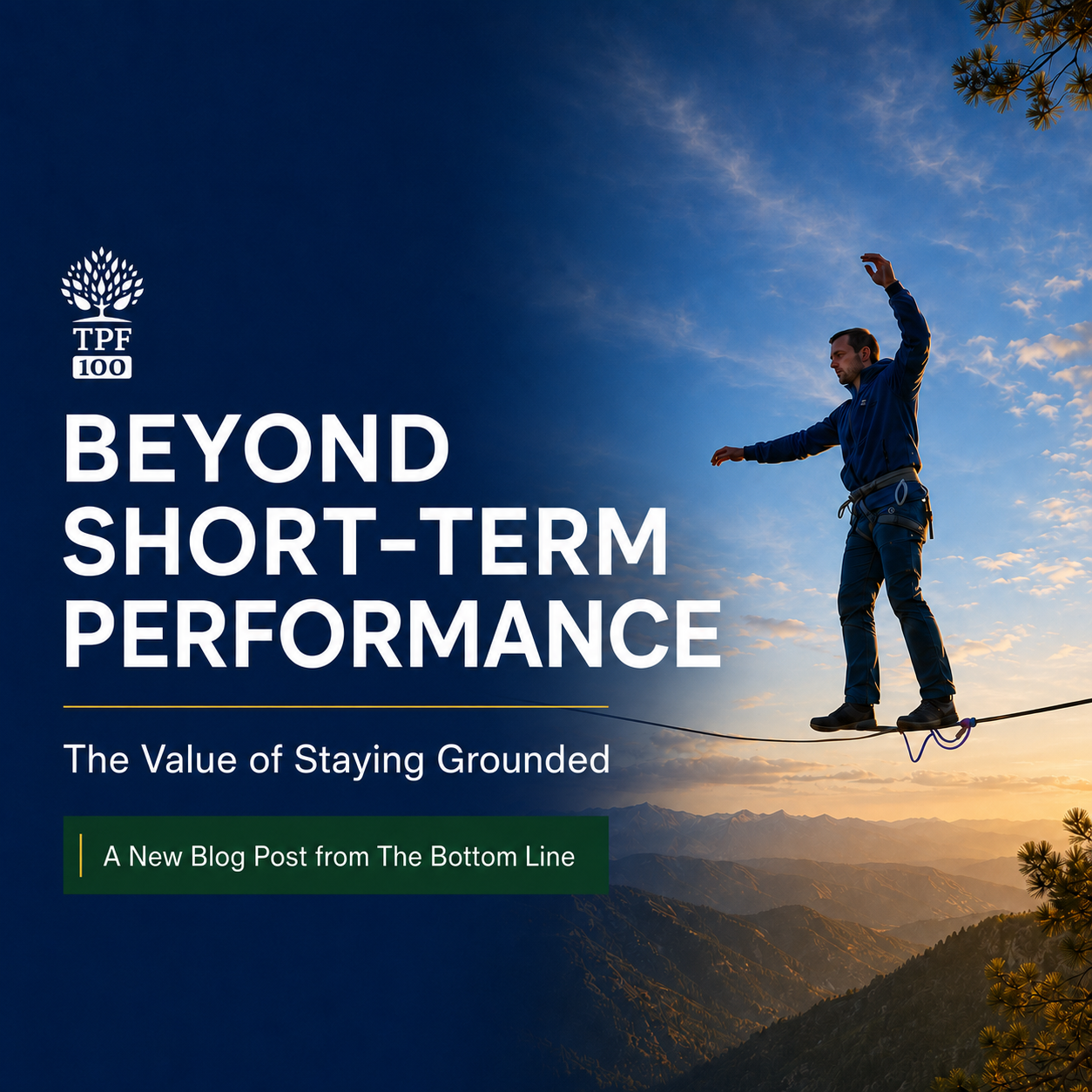
Beyond Short-Term Performance: The Value of Staying Grounded
By Jake Wilson, TPF’s Director of Institutional Investing
Periods like this can test an investor’s confidence in a disciplined, diversified approach. They can also make it tempting to chase the narrow group of investments currently leading the market. However, for institutions investing in support of a lasting mission, short-term performance comparisons should be considered within a broader context—one that accounts for risk, resilience, and long-term objectives.
Below, I have outlined several key principles for investing through uncertainty while remaining focused on long-term objectives:
Staying Grounded When Markets Defy Expectations
There is rarely a shortage of uncertainty in the investment markets, but 2026 has felt particularly unusual.
Investors are navigating questions about inflation and interest rates, elevated stock valuations, enthusiasm surrounding artificial intelligence, and continued geopolitical instability, including the conflict with Iran and its potential impact on energy prices and the global economy.
Given everything happening in the world, one might expect financial markets to behave more cautiously. Instead, major indexes have remained remarkably resilient. In many ways, the markets are not behaving as they traditionally have during periods of comparable uncertainty.
Another important factor is that recent index performance has been heavily influenced by a relatively small group of large technology and AI-related companies. Because major indexes are weighted according to company size, these companies represent an increasingly significant share of index returns. As a result, an index can perform exceptionally well even when the broader market’s experience is much more mixed.
TPF’s active investment strategy has continued to produce strong, positive absolute returns, but our diversified portfolios have recently underperformed certain indexes. We take relative performance seriously, but we also believe it is important to understand what is driving the comparison and to evaluate results over a full market cycle rather than over a short period.
The Long-Term Case for Active Management
An index does not consider whether a company is attractively valued, financially strong, or positioned to withstand an economic downturn. It simply owns more of a company as that company’s market value rises.
Active management allows investment managers to look beneath the surface by evaluating valuations, earnings quality, balance-sheet strength, and downside risks. It also enables portfolios to diversify across companies, investment styles, asset classes, and global markets rather than continually increasing exposure to the securities that have recently performed best.
That discipline can lag during periods of narrow, momentum-driven market leadership. However, history has shown that market leadership changes and that investments leading a higher market are not always the ones best positioned when conditions become rocky.
We saw the value of diversification and active risk management following the technology bubble in 2002, during the 2008 global financial crisis, amid the market declines of 2015 and 2018, during the COVID-19 downturn in 2020, and again in 2022. During these periods, TPF’s diversified portfolios generally proved more resilient than broad equity indexes.
Past performance cannot guarantee future results, but these experiences help illustrate why TPF does not build portfolios solely around what is performing best today.
Benjamin Graham famously observed that, in the short run, the market behaves like a voting machine, but over the long run, it becomes a weighing machine. That distinction is especially relevant in a momentum-driven environment. Popularity and investor enthusiasm can dominate for a time, but ultimately, valuations, financial strength, and business fundamentals matter.
Investing in Support of a Lasting Mission
For churches, ministries, foundations, and other nonprofit institutions, investing is about more than outperforming an index during a particular quarter or year. These assets exist to support a long-term mission.
Institutional portfolios must provide resources for today’s ministries and programs while preserving purchasing power for the people and communities an organization may be called to serve years—or even generations—from now.
At TPF, our goal is not to predict every market movement or mirror an index in every environment. Our responsibility is to thoughtfully steward the assets entrusted to us through patient, diversified, and actively managed portfolios designed to support sustainable spending throughout full market cycles.
Whatever the markets bring next, we remain confident in the principles that have guided TPF over time: disciplined active management, broad diversification, and a steadfast focus on the long-term missions of the institutions we serve.
Are You Ready to Continue the Conversation?
Join us for our upcoming webinar, “THE WORD ON THE STREET, August 2026: A Mid-Year Conversation on Investment Philosophy, Performance, & Perspective,” to hear more about current market conditions, recent TPF fund performance, and how our investment managers are navigating today’s unusual environment. CLICK HERE TO REGISTER TODAY!

Connect with TPF
Our experienced team is ready to help build a financial strategy tailored to your needs.

6100 Colwell Blvd., Suite 250
Irving, Texas 75039
Phone:
1-800-955-3155
214-522-3155
Fax:
214-522-3157


©2025 Texas Presbyterian Foundation. All rights reserved.
Phone:
1-800-955-3155
214-522-3155
Fax:
214-522-3157
6100 Colwell Blvd., Suite 250, Irving, Texas 75039
©2025 Texas Presbyterian Foundation. All rights reserved.